

ABC data stands for Antecedent (what happens right before a behavior), Behavior (what the child does), and Consequence (what happens right after). Tracking these three components helps parents uncover why a behavior occurs.
In ABA therapy, behavior is viewed as a form of communication. When children experience big emotions or engage in challenging behaviors, they are rarely acting out “for no reason.” Instead, they are trying to communicate an unmet need, sensory overload, or frustration. To decode this communication, behavior analysts rely on ABC data.
Breaking Down the ABCs
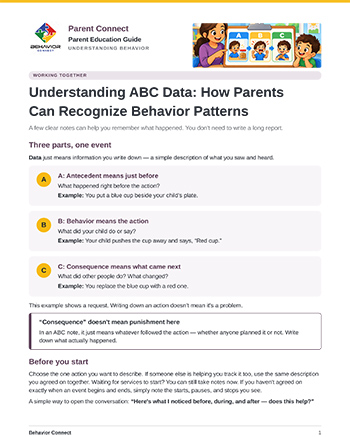
- A — Antecedent: The trigger or event that immediately precedes the behavior. (e.g., You tell your child it is time to turn off the tablet.)
- B — Behavior: The observable and measurable action itself. (e.g., Your child drops to the floor and screams.)
- C — Consequence: What happens immediately after the behavior. (e.g., You hand the tablet back to keep the peace.)
By tracking these patterns over time, you can identify hidden triggers—such as fatigue, transitions, or sensory triggers—and proactively change the environment to support your child.
Additional Reading
Want to dive deeper?
Grab our comprehensive companion article for extra background details and broader perspective on what you just read.